
For many people affected by the Shield Master Fund situation, the money paid into their Macquarie CMA has created a confusing question:
“What do I do with it now?”
In the earlier article, I explained that Macquarie returned 100% of the original Shield investment amount to affected Macquarie members, less any withdrawals, but not always entirely back into super. In many cases, a portion was returned to super and another was paid into a Cash Management Account in the person’s own name.
That detail matters.
Once money is sitting in a CMA in your personal name, it is no longer considered to be inside the super environment. That may create tax questions, but it may also create planning opportunities. The first article explained the broader issue. This one looks at one specific idea:
Using a tax refund strategically, rather than treating it as a one-off bonus.
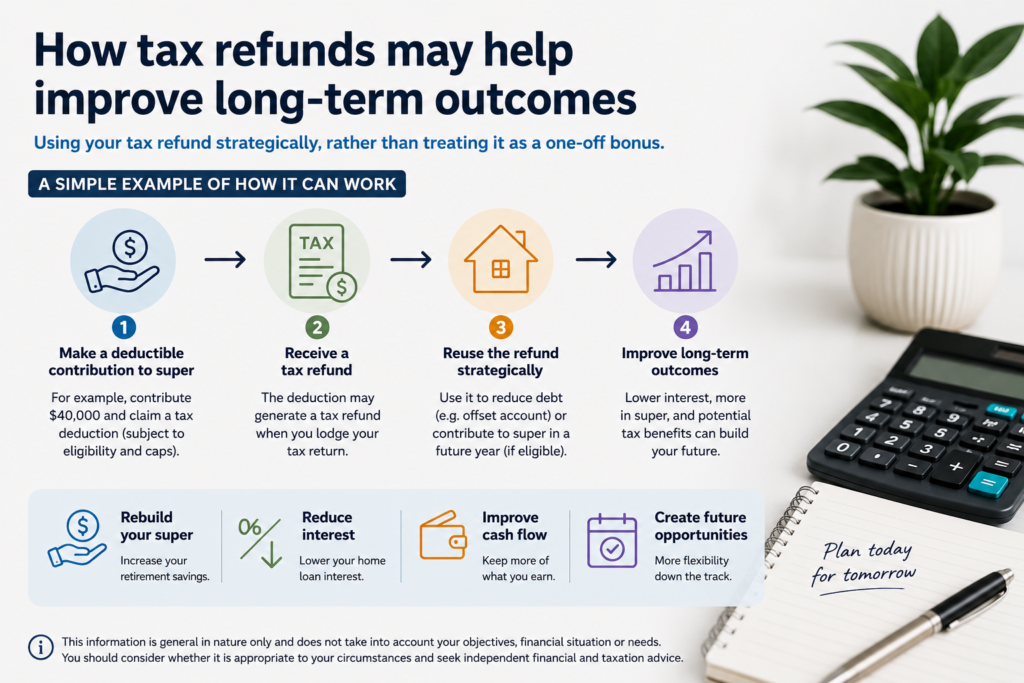
Where someone is eligible, one strategy people often consider is making a personal deductible contribution into super before 30 June.
The ATO states that personal super contributions may be deductible if they are made to an eligible fund, and the person gives the fund a valid notice of intent to claim the deduction. The general concessional contributions cap is currently $30,000, although some people may have unused concessional cap amounts available from prior years if they meet the carry-forward rules. Note: you must check this first before doing anything.
If a person contributes money to super and claims a valid deduction, the contribution is generally taxed in the super fund at 15%, instead of being taxed at the person’s marginal tax rate. The ATO confirms concessional contributions are taxed in super at 15%.
That can create a tax refund. The more interesting part is what happens next.
Instead of spending the refund, the refund can potentially be reused. For example, it may be placed into an offset account, used to reduce debt, or even used as a further super contribution in the following financial year if appropriate.
This is where the same dollar can sometimes work more than once.
A simple example (“The following are simplified illustrative examples only. They do not represent recommendations and should not be relied upon as financial, taxation or investment advice.”)
Imaginary person “Andrew”, aged 54, working full time and earning around $150,000 per year. He received $166,298 back in relation to Shield, including $44,122 paid into a CMA in his personal name. The strategy considered was to contribute $40,000 back into super and claim a deduction, subject to eligibility, available contribution caps and the correct paperwork being completed.
At that income level, a deductible contribution may create a meaningful refund because part of his income sits in the 37% tax bracket before Medicare levy. The ATO’s resident tax rates for 2025–26 show income between $135,001 and $190,000 is taxed at 37%, before Medicare levy.
Using rounded figures, a $40,000 deductible contribution could reduce the amount of taxable income assessed at the individual’s marginal tax rate, subject to contribution rules and eligibility requirements.
1
This would mean that you would receive a total tax benefit of roughly $7,850 when he takes into consideration the tax he will save in his tax return less the tax his super fund pays. But …. this doesn’t tell the full story. As the tax paid in super doesn’t impact his personal cashflow. But his boosted tax refund does. As doing this strategy would mean that it would lead to a tax refund of $13,850. That is right, in this scenario when Andrew made this contribution and claimed the tax deduction, this would mean he would receive an extra of around $13,850 after lodging his tax return.
Then comes the second step.
2
When the tax refund is received, it does not have to disappear into day-to-day spending. It could potentially be used again. It could initially be placed into an offset account to reduce home loan interest. Assuming an interest on your home loan of 6.5% this would save him $900 in interest in a year. Then once it was tax time again, he could contribute the $13,850 into super and get another big tax deduction. His super fund would pay the 15% tax and so his fund would keep $11,772.5.
Assuming that Andrew was still on $150,000 the next year, – this contribution of $13,850 would lead to a tax refund of $5,401.50.
In this way, with no other additional money, that initial contribution of $40,000 has turned into $45,772.5 inside super and he has netted tax refunds of $19,251.50.
Or put another way that $40,000 that was just lying around in his CMA could create $25,024 of extra financial benefit – just by knowing and understanding what the system allows him to do.
Note – this does not include any returns for the year in super of the $900 saved in interest.
That sequencing can turn one decision into two benefits: money is rebuilt inside super, a refund is generated, the refund is then reused rather than wasted or interest savings or further tax benefits may follow.
Why the refund matters
Many people treat a tax refund like a bonus. But in this situation, the refund may be part of a bigger recovery strategy.
For people impacted by Shield, re-contributing some of the CMA money, where appropriate, may help restore part of the retirement balance. Reusing the refund may then help improve cash flow, reduce interest, or create another round of savings.
That does not mean everyone should do it.
It depends on:
• income level,
• tax position,
• available concessional contribution cap,
• super balance,
• age and contribution eligibility,
• cash flow needs,
• mortgage or debt position,
• whether the money may be needed for tax or other future costs, or
• whether a valid notice of intent can be lodged and acknowledged before the tax return is completed.
You must speak carefully assess your overall situation (or speak to a professional) before you start moving money around.
The important warning
This is not a guaranteed strategy and it is not suitable for everyone.
It is also important not to accidentally exceed contribution caps. If unused concessional cap amounts are being used, the ATO says carry-forward concessional contributions are generally available only where the person’s total super balance was less than $500,000 at the previous 30 June.
Timing also matters. For a contribution to count in a financial year, it generally needs to be received by the super fund by 30 June, not merely intended or transferred late.
The takeaway
The Macquarie CMA payment created confusion, but for some people it may also create an opportunity. The real opportunity is not simply receiving a refund. It is what you do with the refund next.
sed carefully, the same money may help rebuild super, reduce tax, lower interest, and improve a person’s overall position over time. Used poorly, it may simply sit in a CMA earning modest interest, or disappear into spending without any longer-term benefit.
This is general information only. It does not take into account your objectives, financial situation or needs. Before acting, you should consider whether the information is appropriate to your circumstances.
Next article is: Using super contributions and spousal splitting to boost tax refunds
General advice warning: The information in this post is general in nature only and does not take into account your objectives, financial situation or needs. Before acting on any information, you should consider whether it is appropriate to your circumstances and seek professional advice where required.
Please note: Examples are hypothetical and simplified for illustrative purposes. Actual outcomes may differ materially depending on contribution caps, taxable income, tax offsets, investment returns, fees, timing and legislative changes. Investment returns are not guaranteed and superannuation investments can rise or fall in value.

Spotting AI investment scams in Australia: Essential Tips

How much super should you really have? The numbers may surprise you
Read time 5min Published21 Jul 2026 For many Australians, retirement feels a long way off….

Financial review improved one client’s Financial position by almost $25,000 in just one year
Read time 7min Published20 Jul 2026 Based on a real story. The client’s name and…

Australia’s property market isn’t moving at one speed – and that’s why strategy matters more than timing
Read time 4min Published19 Jul 2026 Today’s property market is being shaped less by national…
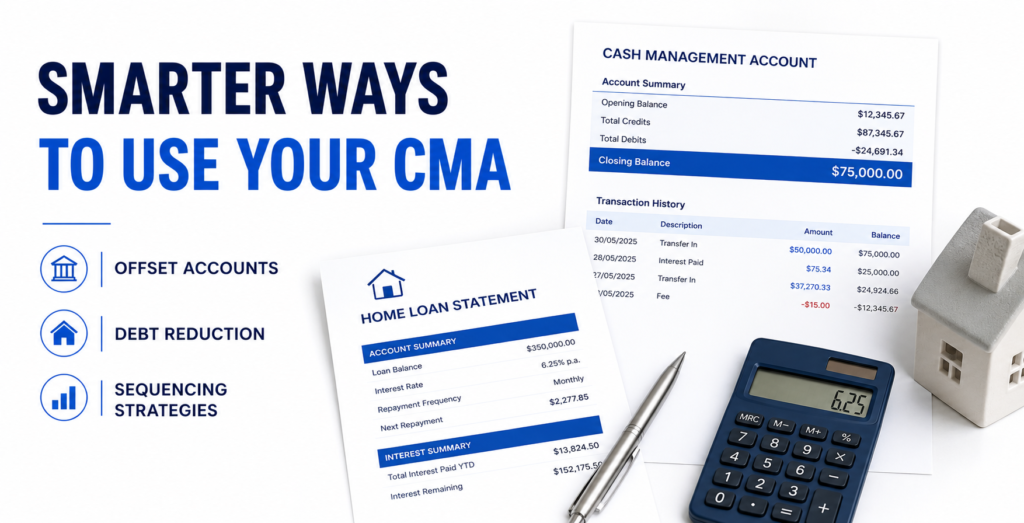
Smarter ways to use your cash — offset accounts, debt reduction and sequencing strategies
For many Australians affected by the Shield Master Fund and First Guardian collapse, receiving a…

Received your CMA payment from Macquarie? Here’s what to know next.
A lot of people I’ve spoken to who received money back from the Shield situation…


Pingback: Spousal splitting, super contribution and boost tax refunds
Pingback: Smarter ways to use your cash in CMA — offset accounts, debt reduction and sequencing strategies - abbrev8-com-au.preview-domain.com