
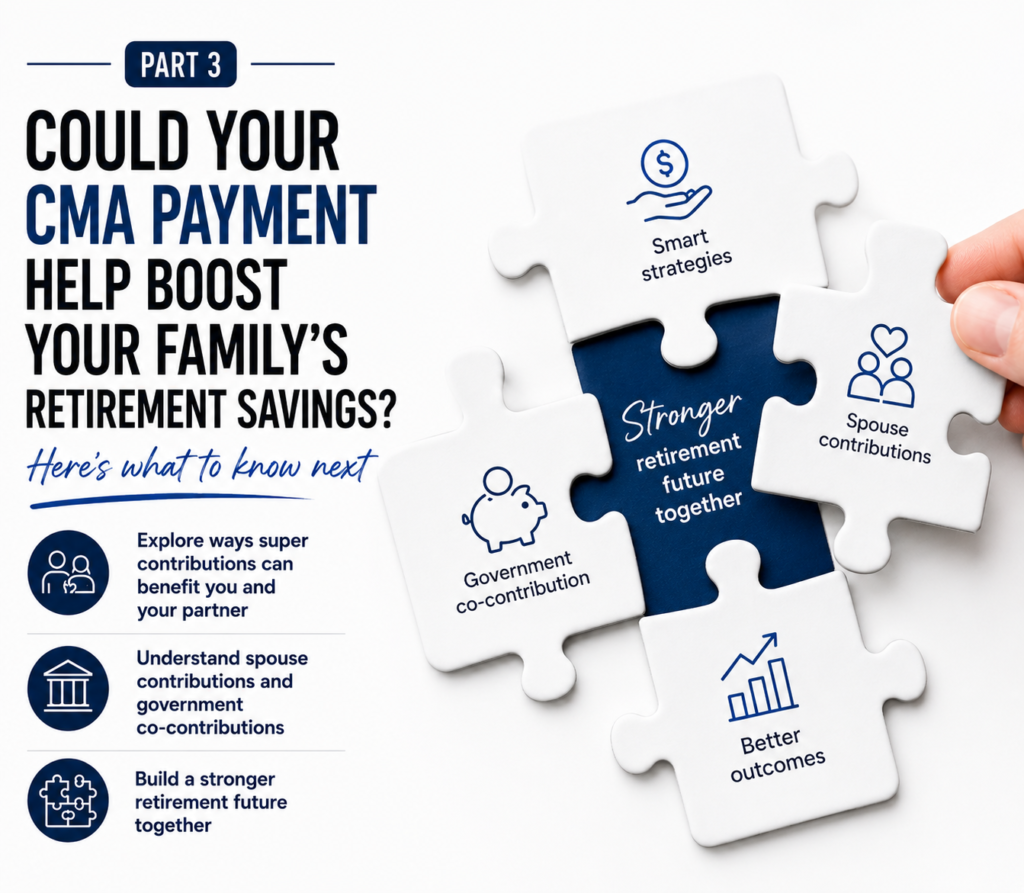
Part 3: Shield Master Fund – Have you received your CMA payment from Macquarie?
This is the third and final article in my series about the CMA payments many people have recently received following the Shield Master Fund compensation payment from Macquarie.
In Part 1, we looked at how some people may be able to reuse a tax refund to create even more savings.
In Part 2, we explored practical ways to use CMA money, including reducing debt, building cash reserves and using offset accounts to improve cash flow.
For this final article, I would like to look at another area many people are asking about: whether this CMA payment could help strengthen retirement savings, either for yourself or your partner.
This is not about rushing into super or assuming super is the right answer for everyone. It is about understanding that there may be options available, depending on your circumstances, eligibility and contribution limits. Pls note this article doesn’t take into consideration your personal circumstances and that is why you should speak to a financial adviser to determine whether any of these options is right for you …
Looking beyond today’s expenses
When people receive a lump sum payment, the first thoughts are often practical ones.
· Should I pay off debt?
· Should I keep the money in the bank?
· Should I use it for home improvements?
All of these may be reasonable options. However, some people also choose to take a longer-term view and ask:
“Could this money help improve our retirement position?”
Why some people consider super contributions
Superannuation is designed to help Australians save for retirement. It also receives concessional tax treatment, which means some types of contributions may have some pretty nifty tax benefits.
However, super rules are not the same for everyone.
Before making contributions, people need to consider things such as age, income, total super balance, existing employer contributions, previous contribution history, contribution caps and whether they may need access to the money before retirement.
This is why it is important to understand the rules before acting.
A fictional example: Robert and Diane
Let’s look at a fictional example (for educational purposes only. To find out if this is appropriate to you please speak to your financial adviser).
Robert and Diane are both in their late 50s and were affected by the Shield Master Fund situation.
Robert recently received a CMA payment and was considering what to do with the money.
Robert works full-time and earns around $110,000 per year. Diane works part-time and earns around $32,000 per year. Robert has built up a stronger super balance over his working life, while Diane’s super balance is lower because she spent many years working part-time and taking time away from work to raise their children.
Rather than only looking at Robert’s CMA payment as extra cash, they started looking at their retirement savings as a household.
Option 1: Spouse contribution
One option Robert and Diane learn about is a spouse contribution. This is where Robert contributes after-tax money directly into Diane’s super account.
For example, Robert may contribute $3,000 into Diane’s super account.
If Diane’s income is below the relevant threshold and the other eligibility rules are met, Robert may be eligible for a spouse contribution tax offset of up to $540.
This does not mean Robert gets the $3,000 back. It means he may receive a tax offset, which can reduce the amount of tax he pays.
This $3,000 contribution would count towards Diane’s non-concessional contribution cap.
Option 2: Government co-contribution
Diane may also consider making her own after-tax contribution into super.
For example, if Diane contributes $1,000 of her own money into super and meets the eligibility rules, the Government will contribute up to $500 into her super account.
For the 2025–26 financial year, the full co-contribution may be available where income is at or below the lower income threshold. A partial co-contribution may be available up to the higher income threshold.
This is not automatic for everyone. The amount depends on income, contribution amount and other eligibility rules.
Option 3: Contribution splitting
This is different from a spouse contribution.
Contribution splitting may allow a person to transfer up to 85% of certain concessional contributions from their super account to their spouse’s super account after the end of the financial year.
Concessional contributions generally include employer super contributions, salary sacrifice contributions and personal contributions where a tax deduction has been claimed.
This does not create extra money. It is simply a way some couples may be able to move eligible contributions between spouses to help balance retirement savings over time or keep their own super balances below certain balance caps.
^ – 85% allowed due to fact that there is the normal 15% contributions tax that is taken out before you can split it to your partner
Why this matters
The important point is not that Robert and Diane should use all of these options.
The important point is that they now understand there may be more than one way to think about the CMA payment.
For some people, the priority may be debt reduction.
For others, it may be emergency savings.
For some couples, it may be worth understanding whether super contributions, spouse contributions, government co-contributions or contribution splitting could play a role in their broader retirement planning.
Retirement planning is often a family decision
One thing the Shield situation has reminded many people is that financial decisions rarely affect just one person.
They affect couples, families and future retirement plans.
A CMA payment may be held in one person’s name, but the decision about what to do with it may affect the whole household.
That is why some people are using this moment to step back and look at where they want to be in five, ten or twenty years’ time.
Final thoughts
There is no single “best” use for a CMA payment. But just wanted to highlight three strategies you may not be aware of. The first two creates a benefit of $1,040 from using $4,000 of the CMA for specific types of contributions.
For some people, reducing debt may be the right choice. For others, keeping access to cash may be more important. For some, strengthening retirement savings for themselves or their partner may be worth considering.
The key is understanding the options, the rules and how each decision fits into your broader financial situation. Hopefully, you know understand there may be more options than you originally thought.
Of course, if there are any questions you may have about these or other financial advice matters, feel free to DM me.
This article contains general information only. It does not take into account your personal objectives, financial situation or needs. It does not constitute personal financial advice, tax advice or legal advice. Before acting on any information, consider whether it is appropriate for your circumstances.
General advice warning: The information in this post is general in nature only and does not take into account your objectives, financial situation or needs. Before acting on any information, you should consider whether it is appropriate to your circumstances and seek professional advice where required.