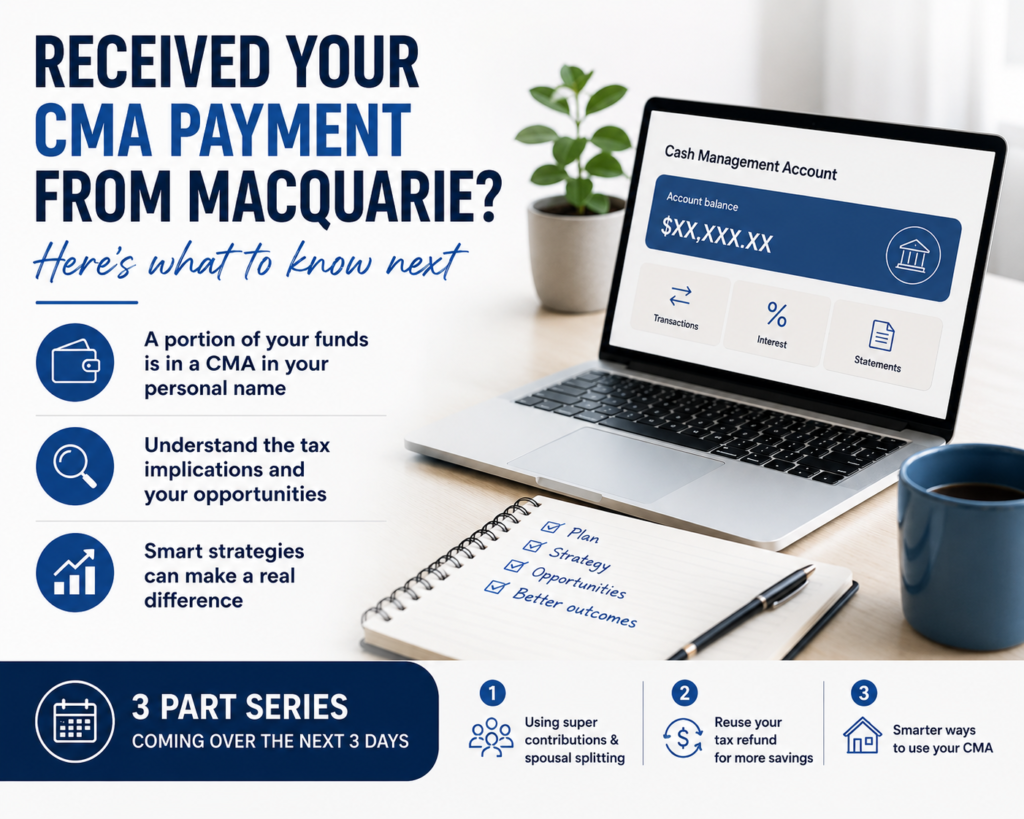
A lot of people I’ve spoken to who received money back from Macquarie for Shield situation believe that their money is now safely back in super. Unfortunately, that’s not quite right. Some of it is… but a portion has actually been paid out into a CMA in your personal name.
Some people have used that money straight away — holidays, renovations, even cars. And that’s completely fine. But quite a few others have reached out asking a different question:
“How do I use this to actually make it work for me?”
“Is there a smarter way to use this money?” Some even said it directly — “Can I use this to make more money?”
So I thought it was worth explaining what’s actually happened here and sharing some general ideas to help you think about your next steps.
Please remember these are only meant to be general advice and don’t consider your individual circumstances. You should check with a professional on how these may apply to you.
What Macquarie has done is return 100% of your original investment (your net capital), but in two parts.
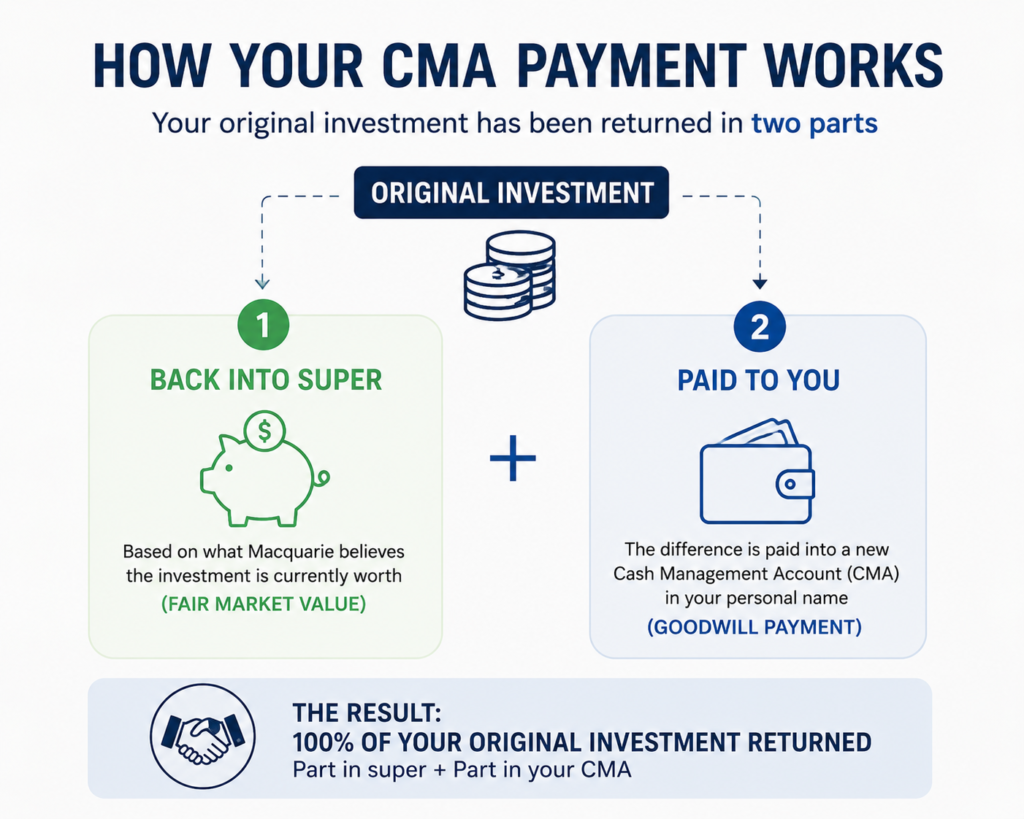
- One portion was paid back into your super account, based on what they believe the investment is currently worth (the “fair market value”).
- The second portion — the difference — was paid into a new Cash Management Account (CMA) in your personal name as a “goodwill” payment to bring you back up to your original investment.
So although it may appear that you’ve been made whole, the key point is that a portion of your funds has shifted out of the super environment and into your personal name—bringing both tax implications and potential planning opportunities.
The CMA itself is simply a type of cash account. Like a traditional bank account it pays you interest on the amount you have on deposit. However, CMA’s typically are not used for saving, instead they are used to settle investment transactions and the like. The most common consequence is that often CMAs have lower interest rates than normal bank accounts. And unless you do something with it… it will just sit there.. And that’s the key point — this money can be put to much better use.
There is still some uncertainty around the tax treatment of these payments. In many cases, the amount paid into the CMA may need to be considered for tax purposes, and depending on how everything is finalised, there may also still be a capital loss position sitting within super. Even professionals are still working through parts of this, so it’s understandable if it feels unclear.
There are also some broader strategies people often look at in situations like this. For example, bringing forward certain deductible expenses before 30 June, making contributions to a spouse’s super where applicable, or structuring finances so that more of their debt becomes tax-deductible over time. Others may look at investing the funds in a way that generates income, rather than leaving it sitting in cash. In some cases, there may also be opportunities to offset gains with losses, depending on individual circumstances.
The main idea isn’t that there is one “right” move, but rather that leaving the cash sitting in the CMA is usually a pretty inefficient use of your funds. Even small adjustments can make a meaningful difference over time, whether that’s through reduced interest, improved returns, or better tax outcomes. For some of these strategies you need to act fast – 30th of June is the CUT OFF.
Even small changes here can make a real difference — in some cases we’re talking thousands of dollars in tax saved or interest reduced, just by using the same money a bit more strategically.
I originally put this together as one post with all the strategies and examples in it… but it quickly became way too long and hard to read.
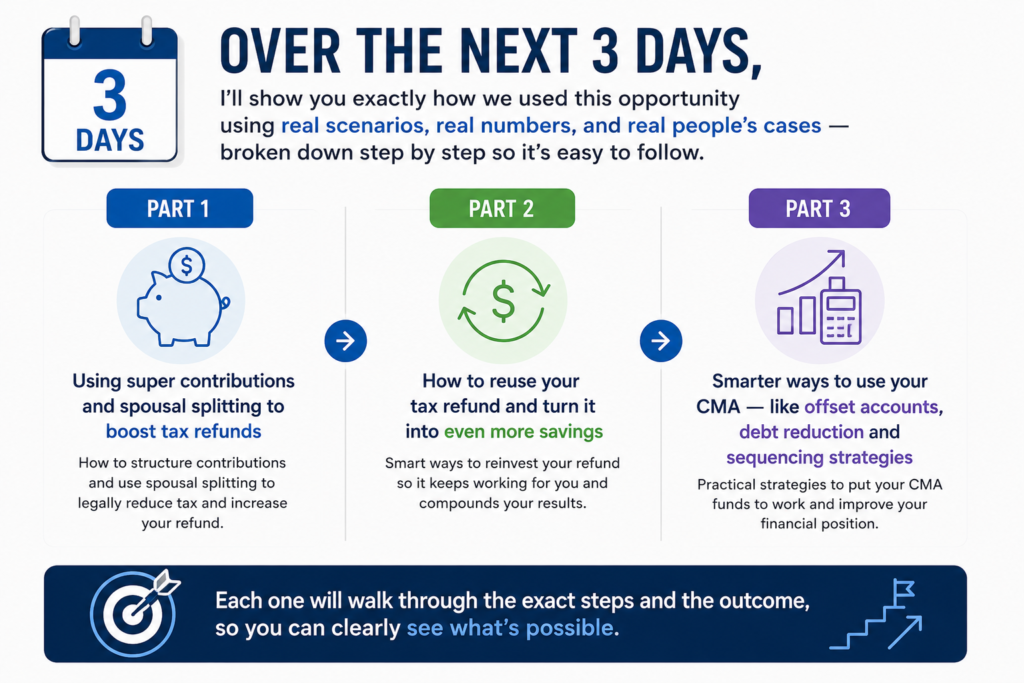
Over the next 3 days, I’ll show you exactly how we used this opportunity using real scenarios, real numbers, and real people’s cases — broken down step by step so it’s easy to follow.
1. How to reuse your tax refund and turn it into even more savings
2. Using super contributions and spousal splitting to boost tax refunds
3. Smarter ways to use your CMA — like offset accounts, debt reduction and sequencing strategies
Each one will walk through the exact steps and the outcome, so you can clearly see what’s possible.