Read time
5min
Published
21 Jul 2026
For many Australians, retirement feels a long way off. But the latest data suggests there’s good reason to check your super sooner rather than later.
According to the Association of Superannuation Funds of Australia (ASFA), a single homeowner aged 67 needs around $630,000 in super for a comfortable retirement, while a couple needs around $730,000. A more modest retirement still requires approximately $110,000 for a single person and $120,000 for a couple. The challenge? Most Australians approaching retirement haven’t reached those levels.
MoneySmart, using Australian Prudential Regulation Authority (APRA) data, reports the average super balance for Australians aged 60–64 is just $263,400—well below the amount often required for a comfortable retirement. There is also a significant gender gap. AustralianSuper’s latest analysis shows women continue to retire with considerably less super than men, largely due to career breaks, part-time work and caring responsibilities.
Average Super Balance by Age and Gender
AustralianSuper publishes average balances by both age and gender, providing a useful benchmark.
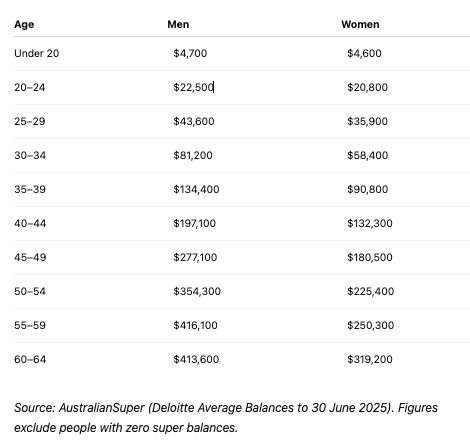
These figures can be helpful for comparison—but don’t panic if your balance is lower. They’re averages, not targets.
A simple example
Imagine two people who are both 45 years old. Michael has $290,000 in super. Emma has $185,000.
Looking at the averages, both appear to be tracking reasonably well. But that doesn’t automatically mean they’ll both enjoy the retirement they want. Michael hopes to retire at 55 and travel extensively. Emma plans to work until 66, owns her home and expects a more modest retirement lifestyle. Although Emma has a much lower balance, she may actually be closer to achieving her personal retirement goals. That’s why comparing balances alone rarely tells the full story.
The better question: Are You On track?
Rather than comparing yourself to averages, it’s more useful to estimate how much you’ll actually need.
Two excellent free calculators are:

MoneySmart Retirement Planner This calculator estimates your retirement income based on your current super balance, future contributions, retirement age and lifestyle goals. | AustralianSuper Super Projection Calculator Estimate how much your super could grow by retirement and model different contribution strategies. |
Running these calculators only takes a few minutes and gives a far more personalised picture than comparing yourself with national averages.
What if your super balance is lower than average?
Finding out you’re behind isn’t a reason to panic—but it is a reason to act. The earlier you make changes, the more time compound investment returns have to work in your favour. Depending on your circumstances, you may wish to consider:
- Reviewing your investment option.
- Making additional concessional and non-concessional contributions.
- Salary sacrificing into super.
- Consolidating multiple super accounts to reduce duplicate fees.
- Checking that your employer is paying the correct Super Guarantee contributions.
- Reviewing your insurance inside super to ensure it’s still appropriate.
Even relatively small additional contributions made consistently over many years can have a meaningful impact on your retirement savings.
Average balances provide useful context—but they don’t determine whether you’re on track. The amount of super you’ll need depends on when you want to retire, the lifestyle you hope to enjoy, whether you’ll own your home, and how long your retirement may last. The best place to start is by understanding your own numbers. Use one of the free retirement calculators, review your current balance, and if you’re unsure what it all means, consider seeking professional financial advice.
Disclaimer
This article contains general information only and does not take into account your objectives, financial situation or needs. Before making decisions about your superannuation, consider seeking personal financial advice.
Resources: